The objective of the General 4 challenge is to begin with five tangent lines and construct from that the conic section and all five points of tangency. The solution in my presentation is lifted directly from Newton’s Principia, Book I, Proposition 27, Problem 19. He supports it with Lemmas 24 and 25, which are presented here. The point labels used here come straight from the book, so it might be useful to read them together.
Lemma 24
If three straight lines, two of which are parallel and given in position, touch any conic section, I say that the semidiameter of the section which is parallel to the two given parallel lines is a mean proportional between their segments that are intercepted between the points of contact and the third tangent.
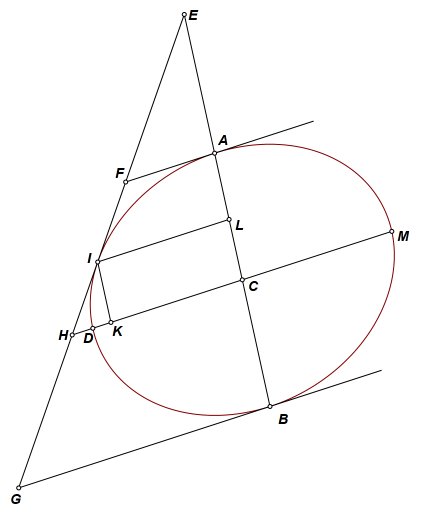
As in the original, the conic section used in this sketch is an ellipse. Every step of it could apply to a circle or a hyperbola. The parabola is excluded, as a parabola has no center, and cannot have parallel tangent lines. The parallel tangents here are AF and BG, parallel to diameter DM. The third tangent is FG, tangent to the section at I. The conclusion of the lemma is that AF, CD, and BG are in geometric progression, and incidentally, this lemma is equivalent to Conica (III.42).
Diameters AB and DM are conjugates, meeting FG at E and H, respectively, and meeting each other at C, the center of the section. Let IK be an ordinate to DM, and complete parallelogram IKCL. By this construction EL must divide AB harmonically, and this proportion follows:
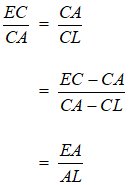
From the above:
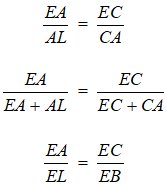
By similar triangles, ΔEAF ~ ΔELI ~ ΔECH ~ ΔEBG:

In the construction of point K it can be seen that HK divides DM harmonically:
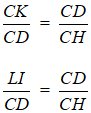
Combine these two proportions:
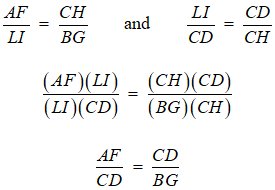
Thus CD is the geometric mean of AF and BG, and the lemma is proved.
Corollary 1
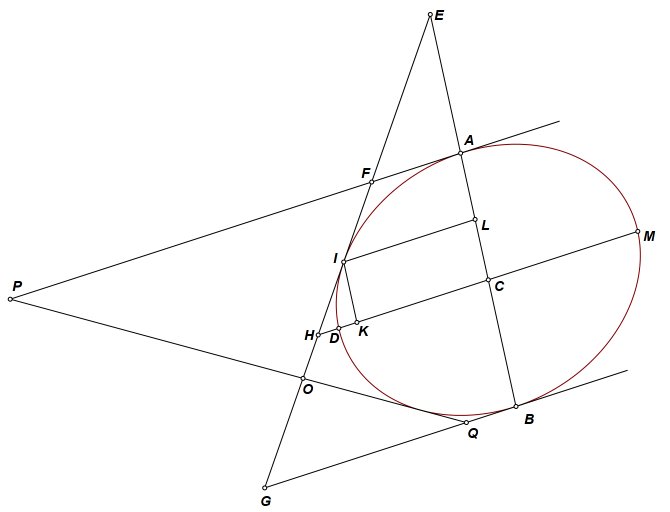
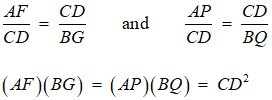
Now introduce a fourth tangent POQ, meeting AF at P, FH at O, and BG at Q. From above:
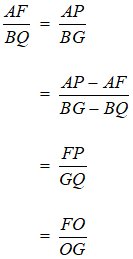
Corollary 2
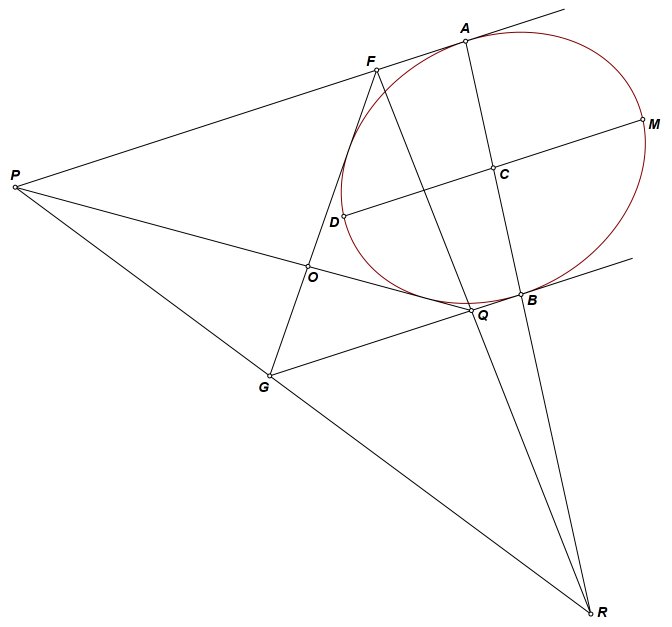
This proportion follows from the conclusion of Corollary 1 above:

This means that transversals AB, FQ, and PG cut parallel lines AP and BG proportionally. The transversals must therefore be concurrent, shown here meeting at point R. In the conic construction it will be important that lines FQ and PG meet at some point on the diameter ACB.
Lemma 25
If the indefinitely produced four sides of a parallelogram touch any conic and are intercepted at any fifth tangent, and if the intercepts of any two conterminous sides are taken so as to be terminated at opposite corners of the parallelogram; I say that either intercept is to the side from which it is intercepted as the part of the other conterminous side between the point of contact and the third side is to the other intercept.
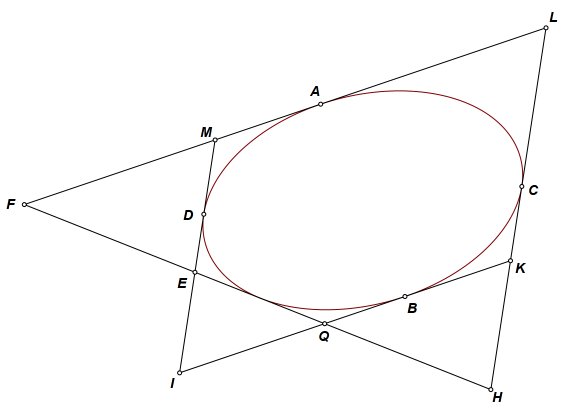
Using an ellipse again for convenience, Let MLKI be the circumscribed parallelogram, with points of tangency A, C, B, and D, as shown. The fifth tangent meets ML at F, IM at E, KI at Q, and LK at H. What must be proved are these two proportions:

Starting from the conclusion of Lemma 24, Corollary 1,
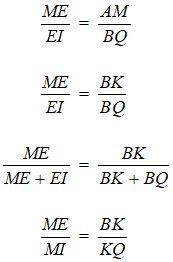
That proves the first conclusion. Now citing the same Lemma 24, Corollary 1,
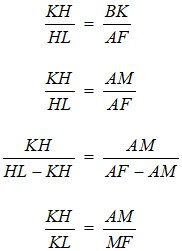
Corollary 1
From the first conclusion of Lemma 25,
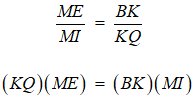
Notice that the right-hand side of that equation is not affected by the position of the fifth tangent line FH. Therefore, once the parallelogram is defined, that also fixes (KQ)(ME). This is also equal to (KH)(MF), as may be shown from the proportions above or from the similar triangles ΔKQH and ΔMFE.
Corollary 2
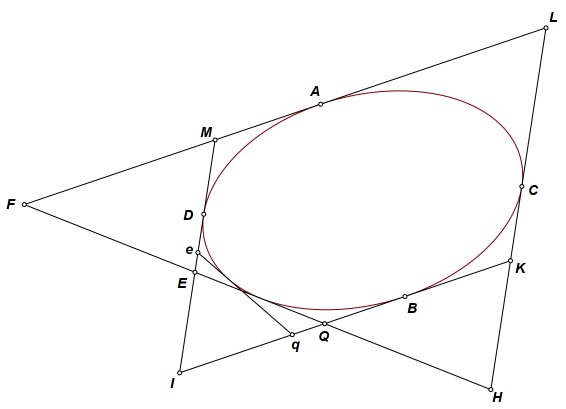
Suppose now that a sixth tangent line, qe, is introduced, meeting KI at q, and MI at e. As shown in Corollary 1, the parallelogram has already fixed (Kq)(Me) as it was before.
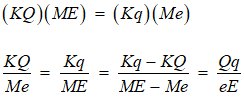
Corollary 3 Substitution
Principia follows this result with a citation of Lemma 23. Line segments Eq and eQ are bisected, and the line joining their midpoints also bisects MK. That midpoint is the center of the section. Unfortunately, after considerable effort, the objective and conclusion of Lemma 23 are not at all clear, nor is it clear how that supports the Corollary 3 conclusion. I do not presume to contradict Dr. Newton. Rather, I simply do not follow, and I am unwilling to publish something I do not understand myself. On the other hand, it is not such an advanced concept, and it can be proved without that lemma. It must be shown that if KQ : Me = Qq : eE, then the midpoints of Eq, eQ, and MK are collinear.
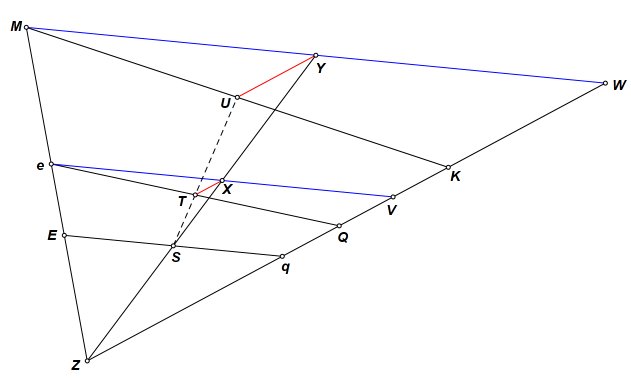
Here goes. The points have been shifted around a bit to make the relationships clearer, but the proportion above is still maintained. Quite a lot has been added, so let it begin with the new conditions.
Let ME and Kq be produced to meet at Z. Lines MW and eV are parallel to Eq, meeting ZK at W and V, respectively. Points S, T, and U are the midpoints of Eq, eQ, and MK. Lines UY and TX are constructed parallel to ZW, bisecting MW at Y and eV at X. The midpoints S, X, and Y are collinear. Now it must be shown that S, T, and U are collinear. They are joined with dashed line segments here because it has not yet been shown that they align.
By the parallel lines MY, eX, and ES,
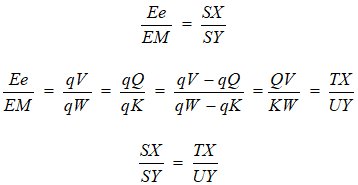
It has been shown that in triangles SXT and SYU, two pairs of corresponding sides are proportional. The included angles are equal, being formed by transversal SY intersecting parallel lines TX and UY. Therefore the triangles are similar.
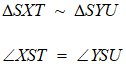
With that, points S, T, and U are collinear.
Back to General 4
Back to General Constructions
Last update: October 14, 2026 ... Paul Kunkel whistling@whistleralley.com
For email to reach me, the word geometry must appear in the body of the message.